Get your phone ready for your big holiday with our pick of the best travel apps
A well-earned holiday is not the time to be burying your nose in your phone, but your trusty dopamine machine can be an invaluable guide on your holidays – you just need to make sure you’ve got the right apps installed. So turn off all your notifications, delete Slack, unsync your work emails and make sure you’ve got all the apps you need for a great break.
As anyone who’s ever stumbled jet-lagged and bleary-eyed onto New York’s Subway can attest, CityMapper is a life-saver. Covering 39 cities from Berlin to Tokyo, its routes and use of data is way better than Google Maps, making it indispensable travel companion for both city breaks and more long-haul trips. In a lot of cities it won’t just tell you how to make your journey, but also how much it will cost. And if you don’t want to scuttle around town on a subway, you can use bus only or cycle routes to do some sightseeing on the way. [Free, Android and iOS]
Duolingo
Don’t. Just. Speak. English. Slowly. And. Loudly. Getting some basic ‘restaurant French’ with this language learning app is quick and simple. With detailed, free-to-access courses in 29 languages, brushing up on your Hungarian before a trip to Budapest is a doddle. Or, if you’re planning a long weekend on Kronos, you can even practice your Klingon. Unlike a book or (heaven forbid) a language learning CD, Duolingo turns learning into a game. And, like all good games, it’s a little bit addictive. Which is great news for when you get lost in rural Japan and need to ask someone for directions. [Free, Android and iOS]
Google Translate
For when Duolingo fails. You can download the language, or languages, you need before you travel and then look up any words you get stuck with. And, if you’ve got Wi-Fi or a data connection on your travels, you can use your phone camera or handwriting to translate on the go. But most useful of all are Translate’s cue cards: tap out a phrase in your language, hit translate, turn the phone sideways and it will display a full-screen translation for someone to read. It’s a fun, if somewhat clunky, way to get by. [Free, Androidand iOS]
Airbnb
Chances are you’ve already got everything booked, but Airbnb’s big new push for experiences makes it a handy app to use when you’re on holiday. From walking tours to cooking classes and kayak adventures to forest therapy, there’s a weird and wonderful range of activities available. [Free, Android and iOS]
HotelTonight
For the traveller that doesn’t believe in planning, HotelTonight has some great deals for bookings made at the last minute. It’s got an easy-to-use interface and some generally amazing deals if you’re willing to take the risk. In some destinations you can even search for availability up to 100 days in advance. In these instances you’d probably be better off looking elsewhere, but HotelTonight is great for spur of the moment reservations. [Free, Android and iOS]
Yelp
Use TripAdvisor if you want to go to where all the tourists go. Use Yelp if you want to go to find something a bit more authentic. It isn’t great in every destination (use https://tabelog.com/ if you’re in Japan, for example), but Yelp is pretty comprehensive for most city break destinations. Want to find a great restaurant or bar nearby? You won’t go far wrong with Yelp. Or, go lo-fi and ask a local. [Free, Android and iOS]
BBC Weather
Will it rain in Marbella?! No, it probably won’t. But BBC Weather, which comes with a handy home screen widget on Android, is a quick and easy way to check the daily and weekly forecast in pretty much any location in the world. [Free, Android and iOS]
TripIt
Every time you making a booking for your big trip, just forward it to TripIt and it will add it to an automated itinerary. It’s probably less confusing than searching back through your inbox for the restaurant reservation you made two months ago. [Free, Androidand iOS]
Beanhunter
Beat the jet lag, or the hangover, with access to details of the best coffee in hundreds of cities around the world. Find cafes, read reviews and add your own photos or comments to help others in the Beanhunter community track down the perfect brew. [Free, Android and iOS]
British Airways
If you must insist on flying British, the British Airways app is one of the better airline boarding pass apps out there. Admittedly the competition isn’t that high, but it’s fast, easy to use and doesn’t have endless unnecessary features. [Free, Android and iOS]
Monzo
Don’t take out €700 in cash. Don’t get one of those prepaid money cards. Don’t use your debit card. One of the best things about Monzo – and there are a lot of good things about Monzo – is it doesn’t charge you any fees on transactions made in foreign currencies. You also get charged using the inter-bank exchange rate, so the price you see is the price you pay. But Monzo is more than just that: it’s a fully-fledged current account with a great app that gives you instant notifications when you spend money. And if you lose you card while on holiday, you can instantly freeze it and order a new one. [Free, Android and iOS]
FourSquare
In a similar vein to Yelp, Foursquare is a handy way of finding local reviews and recommendations for things to see and do all over the world. So rather than ending up at an Angus Steakhouse in Leicester Square, you could find out where people in London actually eat and drink and not have a miserable time. [Free, Android and iOS]
Pocket
Remember all those great long reads you saved to Pocket to read at lunch/on your journey home/at the weekend? Well, now you can actually read them. It’s a great way to kill time and expand your mind during a long flight and, if you want to disconnect from the daily grind of rolling news and social media updates, catching up on some more considered storytelling is a good break for the brain. [Free, Android and iOS]
For GDPR, Facebook is bringing back facial recognition to Europe and Google is battling 4,000 publishers. Not all of big tech is having the same problems
GDPR bolsters the protections of personal data of EU citizens and has had companies scrabbling to meet its requirements. There has been a deluge of pointless marketing emails and companies revamping their privacy policies ahead of the rules coming into force.
All companies large and small, as well as other organisations such as public bodies and charities, are affected by GDPR. And for the very biggest firms, it's an especially crucial issue. Google, Facebook, Twitter, Amazon, Microsoft and Apple hold colossal amounts of information about billions of people around the world. Fall foul of GDPR and they risk being fined huge sums of money.
Each of the big five has taken a different approach to GDPR – with some radical variations between them. We've run down some of the bigger changes made by the companies and their various subsidiaries.
Facebook
Cambridge Analytica has given Mark Zuckerberg a justifiably hard time. Things haven't been made any easier by the implementation of GDPR.
In front of Members of the European Parliament on May 22, Zuckerberg said his company is ready for GPDR and that "a large percentage" of people who have been prompted to update their privacy settings have done so. In a strange twist, Facebook has used GDPR as an opportunity to turn on facial recognition for people in Europe.
Facebook has also moved the registration of about 1.5 billion users outside of the US, Canada and the EU to the United States from Dublin. As reported by Reuters, Facebook's move means people in Africa, Asia, Australia and Latin America are not covered by GDPR. Facebook says it is offering privacy tools to everyone around the world. But these won't be the same in every nation.
Apple
Generally, Apple collected less data than its big tech rivals. As far back as 2011's iOS 5, the firm added end-to-end encryption on iMessages sent between its devices. Unlike Facebook and Google, the company doesn't rely on advertising to make money.
For GDPR, Apple has updated its privacy terms and introduced a new user page. People in Europe can now download all of their data that Apple holds about them. This is broken down by Apple service – Photos, Apple Pay, contacts and more. The downloads come in the form of zipped folders, which hold CSV and JSON files that can be reused.
Apple has also introduced the ability to temporarily deactivate an account. When this is done, Apple services will stop working but the company will also stop using customer data for its machine learning and AI systems. These features will be rolled out to all accounts around the world in coming months.
Google
Like Facebook, Google has come under criticism for its GDPR plans. Primarily, the firm has come under fire from publishers and the groups that represent them. Four major trade bodies that represent 4,000 publishers have complained about Google's changes to its advertising platform. Google's plan to shift the responsibility of getting user consent to use data "would undermine the fundamental purposes of the GDPR", representatives for publishers said.
"It's important to understand that most of our ad business is search, where we rely on very limited information — essentially what is in the keywords — to show a relevant ad or product," Google CEO Sundar Pichai said in April. He added that he thought GDPR was generally a good thing for internet users.
Twitter
Twitter has updated its terms of service and privacy policy ahead of GDPR. "By using our services on or after that date, you’ll be agreeing to these revisions," the firm explained in a blog post.
It hasn't clearly stated what has been updated but says the updates "focus on the controls we offer you over your personal data" and on how Twitter shares your data publicly. Part of its GDPR preparations have also seen Twitter shut down its apps for streaming service Roku, Android TV and Xbox.
Amazon
Amazon Web Services (AWS) is one of the bigger parts of Amazon's sprawling set of services. At the end of March, Amazon announced AWS was ready for GDPR. "AWS services give you the capability to implement your own security measures in the ways you need in order to enable your compliance with the GDPR," the firm explained at the time.
Microsoft
While Google and Facebook have been criticised for their approach to GDPR, Microsoft has announced it will extend the new privacy rights to all its users worldwide. “We believe privacy is a fundamental human right,” the company’s deputy general counsel, Julie Brill, wrote in a blog post announcing the surprise move.
"GDPR is an important step forward for privacy rights in Europe and around the world, and we’ve been enthusiastic supporters of GDPR since it was first proposed in 2012," Brill added.
Microsoft has also created a privacy dashboard that allows people to review settings, delete data, and download information that's held about them. It has also highlighted what it has updated in its Privacy Statement for GDPR.
Solar power is outstripping growth for all other renewables. But as 95,000 megawatt hours just went to waste in California, is the solar surge too much too soon?
Solar is the world’s fastest growing source of new energy, outpacing growth in all other forms of renewable energy, according to research by the International Energy Agency (IEA) published in November. Renewables overall accounted for two thirds of new power added to the world’s grids in 2016, and solar even overtook coal in terms of net growth. This enormous boost has come about thanks in part to the plummeting costs of getting rigged up to wind and solar, as well as massive growth in China and India.
Good times, then, for the Earth’s long-term prospects of continuing to power itself, and taper the consumption of fossil fuels. At the end of April, 85 per cent of German electricity came from renewable sources, establishing a new national record for the country, with breezy, warm and sunny weather combining to create a renewable whammy of unseen proportions.
Last week, solar overtook biomass to become the third source of renewable energy in the US, and renewables in the country now provide 17 per cent of overall electricity, marking good progress, though there is still a way to go with solar only constituting one per cent.
There are various challenges to harnessing the sun’s inexhaustible power, and foremost among them has been cost. But continuous technological improvement and massive economies of scale especially in places like China have turned solar into one of the cheapest renewables around and the easiest to erect in terms of infrastructure. According to Paolo Frankl, head of renewable energy at the IEA, this is "a huge advantage in terms of de-risking investment". The manufacturing capacity globally is now higher than 100 Gigawatts per year, almost the total power capacity of a country like Italy, Frankl says.
While the upfront costs of solar panel installation are still fairly high to the average person, these can be offset in the longer term (for citizens) by subsidisation, incentivising people to bear these costs and allowing them to sell energy back to the grid. Cities have not historically been a natural fit for solar energy because of the space needed to host upturned panels – but companies like Brooklyn SolarWorks have been designing panels which can make use of industrial rooftop expanses and enable communities to buy into these public goods by ‘subscribing,’ eventually reducing their energy costs.
In South London, a number of cooperative initiatives like Brixton Energy and Vauxhall Energy are similarly empowering communities. These sorts of initiative – more and more of which are subsidy-free – are absolutely cost-effective and are – in Frankl's words "a no-brainer... it's actually unstoppable".
A fire six kilometres long has been burning for four days on Manchester's Saddleworth Moor, with more than 50 homes evacuated
Wildfires are a pretty rare occurrence in the UK. And that makes the sprawling inferno covering six kilometres of Greater Manchester moorland all the more impressive and dangerous.
More than 50 homes have been evacuated as a fire that began on Sunday night on Saddleworth Moor escalated during the course of Tuesday night. The fire is being fought by a team of 50 firefighters and ten fire engines.
More than 150 people are thought to have been caught up in evacuations from nearby Carrbrook, and 2,000 acres of moorland are thought to have been been destroyed so far by the fire. Great Manchester Fire and Rescue Service said a helicopter dropped 65,000 gallons of water on the fire on Tuesday, which they describe as "unprecedented in recent times". Flames spread under dry, windy conditions overnight.
A heatwave has been gaining ground across the UK since the weekend, with highs of over 30 degrees celsius in parts of Wales and London on Tuesday. In 2012, wildfire was included as a significant hazard in the UK’s National Risk Register of Civil Emergencies. The annual cost of fighting wildfires in the UK is £55 million, with firefighters attending to about 70,000 grassland fires every year.
The Dutch Refereeing 2.0 project created goal-line technology. Its next creation – VAR – has proven to be more divisive among footballers, fans and pundits at the Russian World Cup
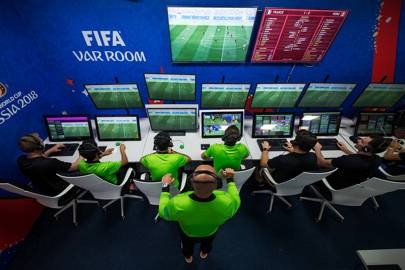
The first video referral in World Cup history happened during the Group B opener between Spain and Portugal, in Sochi. In the 24th minute, Spanish striker Diego Costa clattered against defender Pepe, elbowing him in the face. The defender fell to the ground and, in the sequence of the play, Costa sent the ball into the corner of the net. As Spain celebrated equalising the match at 1-1, referee Gianluca Rocchi consulted the video assistant referee (VAR) using his headset, asking if he had seen anything wrong with the play. The VAR, who at the time was sitting in a video operations room in Moscow, 1,620km away from the action, replied that all was OK. The goal was allowed to stand.
"It was a clear foul,” Fernando Santos, Portugal’s boss, said after the match. Even Spain's Diego Costa agreed: "I saw it afterwards. You could give a foul. It's the referee's interpretation." When asked about VAR, he added: "I don't like it… I scored a goal but I didn't know whether to celebrate or not. If there is a questionable part of the play, you don't celebrate. It can make you look stupid."
VAR was conceived as part of an ambitious project conducted by The Royal Netherlands Football Association (KNVB) called Refereeing 2.0. Its aim? To reinvent refereeing. "With all the 4G and Wi-Fi in stadia today, the referee is the only person who can’t see exactly what is happening and he’s actually the only one who should," says Lukas Brud, IFAB secretary at the International Football Association (IFAB). "We knew we had to protect referees from making mistakes that everyone can see immediately." One of the project’s first successes was the introduction of goal-line technology by FIFA in 2012, after a two-year trial conducted by KNVB. Thanks to that, at World Cup matches, referees are now instantly alerted when the ball completely crosses the line, via a technology developed by British tech company Hawk-Eye. (The same company widely adopted in professional tennis). “Soccer has always been very conservative when it came to the introduction of technology,” Brud says. “We knew that we are opening a very wide door and that if we started down this path, there would be no way back.”
In 2014, KNVB began informally petitioning IFAB, the organisation responsible for developing the laws of the game, to introduce video-assistance in football matches. However, it was only after the departure of FIFA’s disgraced boss Sepp Blatter, a man notoriously adverse to football's technological enhancement, that the project received proper consideration. In October 2015, FIFA’s new boss, the Swiss-Italian Gianni Infantino, held a preparatory meeting at FIFA’s HQ in Zurich to consider the Dutch proposal for VAR. The idea was well received. Most of the members of the football body were of the opinion that there had already been enough high-profile controversies in football – from Thierry Henry’s handball that qualified France to the 2010 World Cup at the expense of Ireland to Frank Lampard’s disallowed goal against Germany in the World Cup of 2014 – that justified seeking a solution that would prevent similar errors in the future. “Those were serious incidences that could have been easily corrected with assistant referees," Brud says. "If we had mentioned the idea of introducing video referees in 2010, people would say we were crazy, but now they saw it as an oppourtunity to help referees and to achieve fairer outcomes in a match."